The Use of Coordinates
Class 09 MathsThe two-dimensional coordinate system uses two lines at right angles to each other to mark points in two-dimensional space (2-D space). The horizontal line is called the x-axis and the vertical line is called the y-axis.
The point of intersection of the x-axis and y-axis is called the origin O. Its coordinates are (0, 0). Coordinate axes help us to locate any point in 2-D space using the point’s coordinates.
Distances to the right of O or upwards from O are considered positive, and distances to the left of O or downwards from O are considered negative.
The plane in which the axes are situated is called the Cartesian plane, the coordinate plane or the xy-plane. The axes divide the plane into four parts, called quadrants.
- Points in Quadrant I have both x- and y-coordinates positive.
- Points in Quadrant II have negative x-coordinate and positive y-coordinate.
- Points in Quadrant III have both x- and y-coordinates negative.
- Points in Quadrant IV have positive x-coordinate and negative y-coordinate.
The coordinates of a point P in 2-D space are represented by (x, y). Here, x represents the perpendicular distance of P from the y-axis, measured along the x-axis, and y is the perpendicular distance of P from the x-axis, measured along the y-axis. x is the x-coordinate and y is the y-coordinate of the point (x, y).
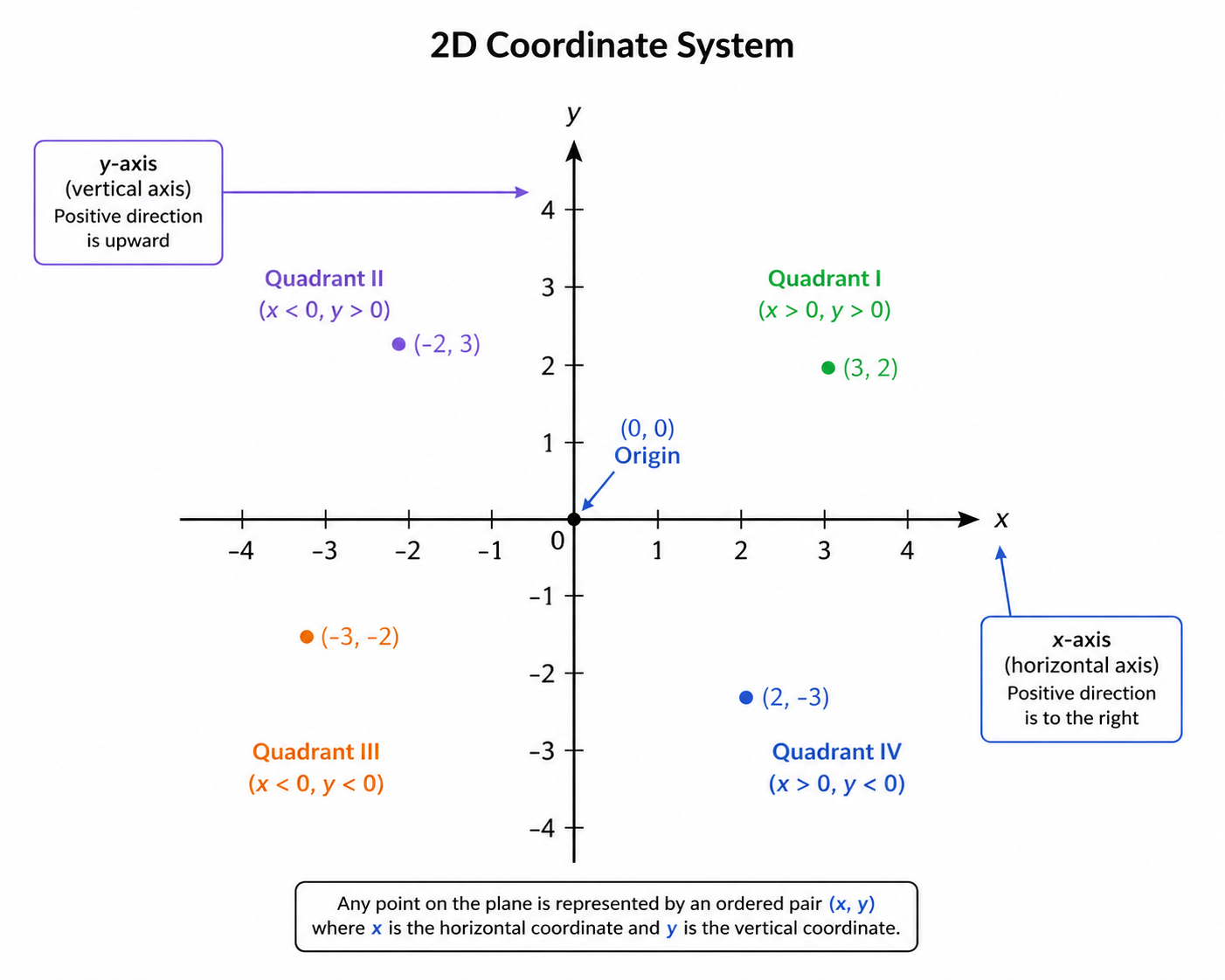
The coordinates of a point on the x-axis are of the form (x, 0), and those of the points on the y-axis are of the form (0, y). The coordinates of the origin are (0, 0).
Distance Between Two Points
The distance between points (x1, y) and (x2, y) is the absolute value |x2 - x1| of the difference between x1 and x2.
The distance between points (x, y1) and (x, y2) is the absolute value |y2 - y1| of the difference between y1 and y2.
The distance between points (x1, y1) and (x2, y2) is
$$ d = \sqrt{(x_2 - x_1)^2 + (y_2 - y_1)^2} $$