Circles: I'm Up and Down, and Round and Round
Class 09 MathsEvery circle has a centre. All points on the circle are at equal distance from the centre.
Definitions
A circle is the set of all points on the plane that are equidistant from a given point on that plane. A circle can also be described as the locus of points that are equidistant from a given point.
The given point is the centre of the circle. The distance from the centre to any point on the circle is the radius of the circle.
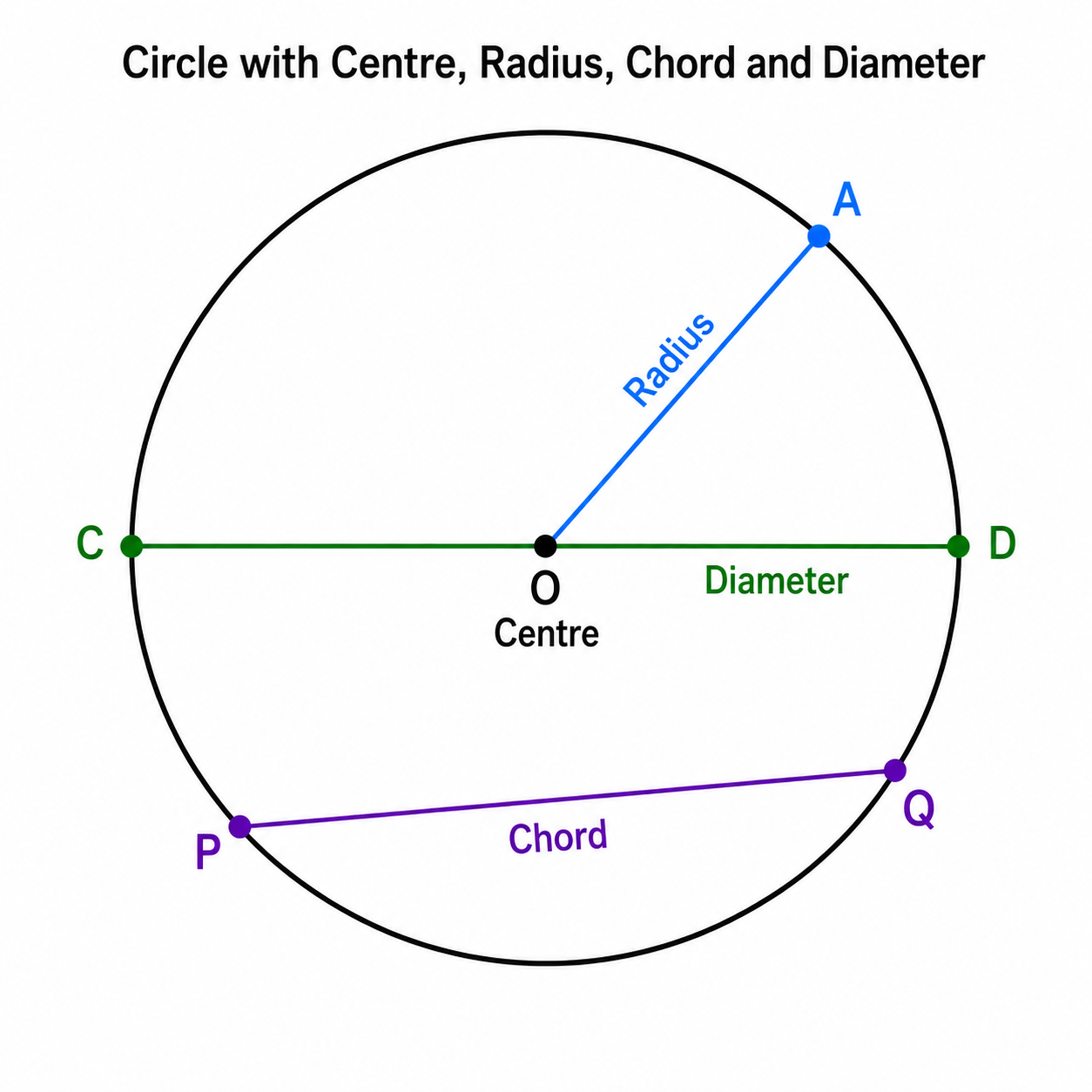
A chord passing through the centre of a circle is called a diameter.
How Many Circles?
Two Points
If a circle passes through A and B, it has a centre, say O. The lengths OA and OB are equal. The midpoint of segment AB is centre. A circle passing through A and B can be drawn. Its radius is half the length of AB, and AB is a diameter.
The perpendicular bisector of the line segment AB is the locus of points equidistant from A and B. Every point on the perpendicular bisector is equidistant from A and B, and every point that is equidistant from A and B is on the perpendicular bisector. So, the centres of all circles through A and B lie on the perpendicular bisector of AB.
Infinitely many circles can be drawn through two given points. The centres of these circles lie on the perpendicular bisector of the line segment joining the two given points.
Three Points
Given any three points not on a straight line, a unique circle can be drawn through them. It is called the circumcircle of the triangle whose vertices are the three given points. The centre of this circle is called the circumcentre of the three points, lies at the intersection of the perpendicular bisectors of the line segments joining the points.
Theorem 1: There is a unique circle passing through three non-collinear points.
Chords and the Angles They Subtend
Theorem 2: Equal chords of a circle subtend equal angles at the centre of the circle.
Theorem 3: Chords of a circle that subtend equal angles at the centre are equal.
Midpoints and Perpendicular Bisectors of Chords
Theorem 4: The line joining the centre of a circle and the midpoint of a chord of the circle is perpendicular to the chord.
Theorem 5: The perpendicular from the centre of a circle to a chord of the circle bisects the chord.
Distance of Chords from the Centre
Theorem 6: Chords of a circle having the same length are all at the same distance from the centre of the circle.
Theorem 7: Chords of a circle that are equidistant from the centre have equal length.
Theorem 8: Let AB and DE be two chords of a circle with centre C. Suppose AB > DE. Then the distance from C to AB is less than the distance from C to DE.
Angles Subtended by an Arc
An arc of a circle is a connected portion of the circle. It is defined by two points on the circle, called the end points of the arc, and the curve connecting them along the circle’s edge.
Theorem 9: The angle subtended by an arc at the centre of the circle is double the angle subtended by the arc at any point on the circle outside the arc.
Corollary: The angle subtended by a diameter at any point on the circle is 90°.
Concyclicity of Points
Theorem 10: If a line segment AB joining two points A, B subtends equal angles at two other points C, D that lie on the same side of AB, then the four points lie on a circle.
Theorem 11: The sum of two opposite angles of a cyclic quadrilateral is 180°.
Theorem 12: If two opposite angles of a quadrilateral add up to 180°, then the vertices of the quadrilateral lie on a circle, i.e., they are concyclic.